Breakfast for the Unstoppable Woman

Nonna turned 90 this month. Which means, amongst other things, that she has witnessed the world transform itself over a span of 9 decades. NINE! How do you celebrate the birthday of someone who has been around for the rise and fall of 42 Italian Prime-ministers, the inauguration of 8 popes, 1 World War and the birth of their first great-grandchild?

Well, it seems only right to give her exactly what she asks for. “Brakfaste. Con il pannecake.”

She uses the word thoughtfully and with intention. While there is a term for “breakfast” in Italian (prima colazione), the two are hardly interchangeable. Traditional colazione in Italy usually consists of nothing more than a dry biscuit and a caffè latte, if that. When I stayed with a second-cousin in Florence a few years ago, she took great care to stock the pantry with what she thought would cater to my North American sensibilities – sugary cereal, pre-packaged “croissants” and individually-wrapped crostate – each specimen coated with the faint aroma of factory plastic. At some point in our co-habitation, she came to understand that I’d much rather have the traditional “S” biscuit and coffee than ready-to-eat factory pastries. (There’s a handful of processed foods that have a special place in my heart – probably quite literally – but this stuff? No grazie.) I imagine that most contemporary Italian families have things like yogurt and toast in the morning. But for the older batch, breakfast still isn’t emphasized as a meal. Not even on weekends.

Here, however, we’ll get together on occasion for a familial Canadian-style breakfast, with scrambled eggs and pancakes and bacon and filtered coffee. And despite it not being something my grandmother grew up with, she has come to fully embrace its merits, amongst them, baked beans – ones made Québec-stylewith brown sugar, a healthy dose of molasses and a few sizeable chunks of lardon. Sure, it’s not a skinny dish. But it’s not like you’re eating it everyday. It’s for special occasions, hearty gatherings…like 90th birthday parties.

—–

The recipe below has been swiped from my mom’s collection. It’s based on the traditional fèves au lard (a.k.a “bines“) that you can find on most breakfast menus in Québec. It may not be the most delicate-looking, but it is a thing of beauty, I assure you. Through the beans simmer quite a long time, they are still toothsome; the sauce is pleasantly sticky, sweet and tangy. Everything a good baked bean should be.

Baked beans

Mom’s Baked Beans (Fèves au lard)

Serves 8-10 as a side

*Note: give yourself several hours for these – they are not hard to make, but it takes time to make good ones (see details below)

  • 1 pound dried navy beans, soaked overnight
  • 5 cups cold water
  • 1/2 pound salted pork belly cut into 1″ pieces
  • 1 onion, chopped
  • 2 tsp cider vinegar
  • 1/2 cup ketchup
  • 1/2 cup dark molasses
  • 1/4 cup brown sugar
  • 1 tsp dry mustard
  • 1 tsp salt

Cover the beans in cold water and soak the beans overnight. The next morning, strain and rinse the beans. Add the beans to a pot with 5 cups of fresh cold water. Boil for 30 minutes. Do not add salt to the water as this hinders the cooking process. Transfer the beans and water to an ovenproof casserole. Stir in the remaining ingredients. Cover and bake in a 250ºF oven for 7-8 hours.

Greek jigsaw puzzle

Sometimes the decision to make one meal over another comes down to what’s hanging out in the fridge. It’s not romantic. Or intellectual. It just, is.

But that’s ok, because I think a lot of us are predisposed to rifling through the fridge (and pantry), rounding up what’s there and assessing our options. If there’s something missing, I might excavate something from the freezer (pesto, rapini, cooked canelli beans…) or head to the store to fill in the blanks. It might not be the most exciting way to pull together a meal, but the act of selecting and matching disparate items from your kitchen and making something delicious can be pretty satisfying – like watching a jigsaw puzzle come together. And this nerd LOVES a good jigsaw puzzle. Like this one, for instance.

It’s a Tuesday night, and I have exactly six things in my fridge aside from condiments, some butter and a sad-looking yellow pepper: phyllo, eggs, spinach, green onion, feta, cream – a Greek sextet that cleanly spell out:

SPA-NA-KO-PITA

The missing piece here is the dill, for which I will have to make an excursion through the remnants of a 30cm snowfall. But the dill is crucial, so I suck it up and suit up.

—–

A little while later, laying eyes on the final product – a flaky confection of souffléed eggs speckled with bright green spinach and soft feta – I am consoled that it was worth every slushy step.

Spanakopita

Spanakopita (makes about 4 servings for a meal)

(Note: This recipe is one that my mom was given by a friend via a Greek woman in the 70s – in other words, this recipe has total Greek cred. It was a staple at dinner parties, when mom would fold them into bite-size triangles and serve them around the room while guests drank cocktails – a notion that conjures up images of people in brightly-colored florals, walking around holding a spinach pastry in one hand and a Harvey Wallbanger in the other. Everyone smoking indoors. It’s probably not exactly how things went down, but that’s how I like to imagine it. Growing up in the 80s, I just remember them being an exciting feature at family gatherings…and also being the first thing to vanish off the buffet table.)

Ingredients:

1 lb. (1 package) fresh phyllo dough
1/2 cup melted butter
16 oz fresh spinach
4 green onions
large handful fresh dill (about 1/2 cup finely chopped)
1/4 cup finely chopped parsley
1 cup crumbled feta cheese
4 eggs well beaten
1/2 cup 35% cream
pinch of salt
pinch of pepper

Directions:

In a small amount of boiling water, cook the spinach leaves just until wilted. Transfer to a bowl of ice water until completely cooled. Drain the spinach, wring with your hands to remove the moisture and set aside. In a food processor, finely chop the green onions and set aside. Put the dill and parsley in the bowl of the food processor, finely chop and set aside. Pulse the cooked spinach a few times in the food processor.

Heat about 2 tablespoons of butter in a frying pan and cook the green onions on medium heat for 1 minute until translucent. Add the dill and parsley, season with the salt and pepper, and continue cooking an additional minute, until soft. Remove from the heat and combine with the spinach. In a separate bowl, beat the eggs and whisk in the cream. Add the spinach mixture and the crumbled feta cheese to the eggs. Set aside.

Preheat the oven to 375°F

Brush the bottom of an 8×8 inch baking pan with butter. Place one sheet of phyllo in the pan and brush with butter. Repeat until you have 6 layers. Place the spinach mixture on top of the phyllo and spread evenly.

Now, you have 2 options:

1)     Take the edges of the phyllo that are spilling over the pan and fold them over the top and brush with butter.

OR

2)      Trim the edges and add another 6 layers of phyllo dough, each brushed with butter.

Place the pan in the oven and bake at 375°F for 25-30 minutes or until golden brown. Serve with a simple green salad.

Beating the drum for breakfast in bed

It started like any other Saturday – flip on the computer, the radio, get the Bialetti on the stove. Bored with eggs for breakfast, I tossed together a scone batter, cut it into segments and popped the pieces into the oven. Waiting for them to bake, I sat half-awake in front of my laptop, steeping in the newsreel trance that is social media.

Then I thought, Forget this. I’m going back to bed.

The timer went off, the scones came out of the oven. I shut off the computer, grabbed some coffee, a glass of juice and this month’s issues of The Walrus and Saveur and slid back under the sheets.

I bid you to not underestimate the power of breakfast in bed. It may feel lazy and backward and counter-productive (because you got your butt into gear to make breakfast, and now you’re back where you started). But it effectively breaks the routine and is a nice way to say “I like you”, to your partner, your kids and to yourself. Lounging around in a crumpled duvet with a magazine or the paper and a spread of food is, without a doubt, a prime way to start your weekend. Especially if Bill or Lou or Mulatu are accompanying you. And unlike meeting friends for brunch, you can stay comfortably unkempt, half-clothed and disheveled and bask in the glory that is breakfast sans bra. Don’t worry – Bill, Lou and Mulatu won’t mind.

Bfast spread

Orange-scented scones – adapted and translated from Josée di Stasio

  • 2 cups all-purpose flour
  • 2 tsp baking powder
  • 1/4 cup sugar
  • 1/2 tsp salt
  • 1/4 cup cold butter, cut into cubes
  • 2 tsp orange zest
  • 2 eggs
  • 1 tsp vanilla extract
  • 1/2 cup 35 % cream
  • demerara (raw) sugar for sprinkling – optional

Directions

Preheat oven 400 ° F and cover a baking sheet with parchment paper.

Sift flour, baking powder, sugar and salt into a medium bowl. Incorporate the cold butter into the flour with your fingers (or if you have hot hands, use two knives or a pastry blender) to reduce the pieces of butter the size of peas. Add the orange zest and stir to combine.

Whisk together eggs, cream and vanilla. Make a well in the center of the dry ingredients and pour the wet mixture into it. Stir quickly with a fork, bringing the flour into the center. When the mixture is almost amalgamated, transfer the dough on the floured work surface and knead just to make the dough. Add a little flour if necessary.Try not to overknead.

Roll out the dough with the palm of your hand about 1 inch thick in a circle 9 inches in diameter. Cut the dough disk into 8 wedges. Place the wedges on the prepared baking sheet, leaving about 2 inches between each scone. Sprinkle the surface of the scones with raw sugar.

Bake for about 10 minutes. Serve with jam, marmalade (my personal kryptonite) and/or softened butter.

(Note: I like my scones as basic as possible, but Di Stasio suggests adding raisins or dried cranberries to hers. Feel free to incorporate half a cup of either once you’ve incorporated the butter.)

Scones

Domestic foodscapes – a reflection

My relationship with my kitchen has been a complicated one. It’s a space I love to hate. True, there are certain moments when it feels really good being in it – like trolling around in wool socks and silk karate pants on weekends with an espresso and the newspaper, or on a mid-week night when I decide to make brownies or cookies or granola at 10pm so the apartment can smell of hot sugar by bedtime. And on certain levels, I feel that we understand eachother. It’s gotten used to my klutzy moves and my swearing and my need to have something blabbing away loudly while I cook – This American Life, Twin Peaks and…sweet mercy save me…Coronation Street. And I’ve gotten used to its puny cupboards and schizophrenic oven and its little surprises – like the time I came back from the cottage to find a brood of pantry moths and carpenter ants hosting a food party in my cupboard, forcing me to chuck nearly everything, scrub every nook and cranny with a vinegar-soaked toothbrush and seal all cracks with caulking. It wasn’t a very romantic moment for my kitchen and I. 

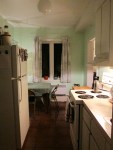
My kitchenette is not what you might call a cook’s dream – it’s the kind real-estate agents have been trained to describe as “quaint” or “cozy”, the space they show you quickly before whisking you away to a larger, more impressive room, in the hopes of whitewashing your memory of it. But something happened this weekend to give me a new-found appreciation for my kitchen space. I spent the better part of Saturday at a workshop organized by the Canadian Centre for Architecture, a sort of conversation/presentation/tasting event that addressed the theme of food in the built environment. Led by one of the founding members of Concordia University’s Food Studies Research Group, the workshop de-constructed the idea of “domestic foodscapes”, encouraging us to consider the relationship between how we feed ourselves and the space(s) in which we choose to do it.

Now, the notion of choice in our domestic environment can sometimes be a tricky one – many of us feel bound by limitations when it comes to spatial arrangements at home. I think that this even more palpable for those of us who are renters, as we generally can’t make substantial changes to our environment (I even signed a contract separate to the lease requiring me, amongst other things, to have my paint colors approved by my landlord). In arrangements like these, choices feel stifled, limited, controlled. But as leasers, we also understand that there’s not a whole lot we can do about it. Some of us accept it; some of us rail against it. When it comes to my kitchen – the place I spend most of my non-work waking hours – I fall into the railing-against-my-reality category. I bitch about its knob-less cupboards, its minuscule prep space, its tiny eating area, its bizarre placement right off the bathroom. But then I realise that I’m doing the thing we all do – complaining about what we don’t have by falling into the “if only” trap. I would make better _____ if only my kitchen had ____. The workshop at the CCA resonated with me; it helped shine a light on the things I do like about my domestic foodscape – my army of mason jars, my vintage scales and colanders, my Bialetti stovetop espresso maker, my teak table and mid-century lamp…

I’ve come to realize that if I really hated this space so much, I wouldn’t store and exhibit such precious items in it.

I’m learning to focus on the things I love about my crazy-ass kitchen. Because, despite its imperfections and idiosyncrasies, it still enables me to do what I need to…

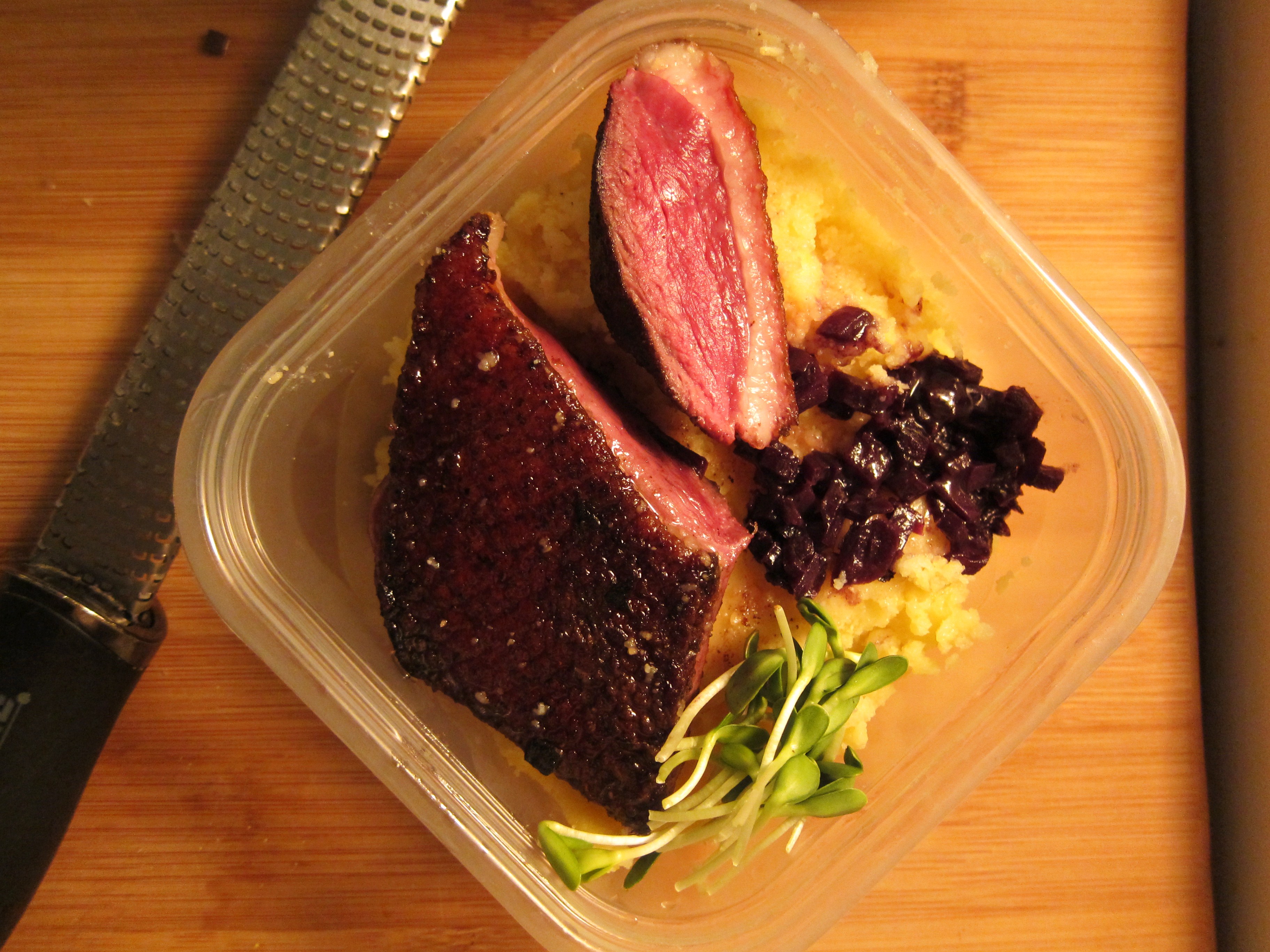
…like, making pretty sexy boxed lunches…

duck box lunch

Her Italian Clark Gable

A few days ago I spent an evening with my Nonna. It’s rare that we find ourselves sharing some time and space together without any other family members in the mix, but on this particular night, circumstances lined up in such a way that it was just her and I. Nonna and nipote.

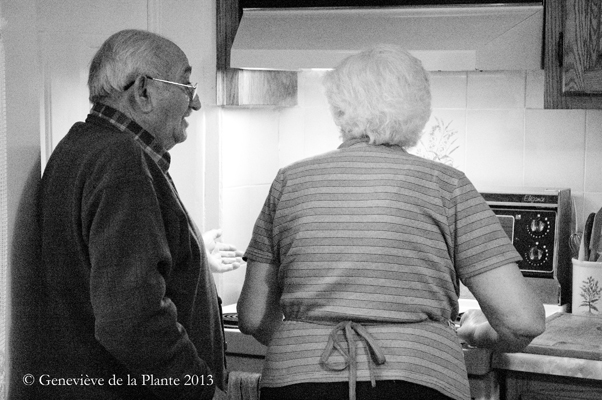
We put together a simple dinner – pasta with Swiss chard and ricotta – teasing each other about the “right” way to make it, a sort of a ping-ponging of questions and answers wherein I attempt (quite unsuccessfully) to enforce my points in broken dialect. We discuss the merits of handmade ricotta versus store-bought; she chops some chard and I watch over the garlic frying on the stove. Side-by-side in her kitchen, we reminisce about little details, many about my grandfather – how he liked his pasta cooked into oblivion; how he used to always help himself to seconds; how much he loved having people over for dinner, with a carafe of his homemade wine stationed on the table. His wine was practically undrinkable and we always complained that the pasta was overcooked – but we were happy.

Nonno didn’t talk much during meals, often telling us we talked too much, but he still found moments to inject a zinger or two into the conversation – usually something he knew would get a rise out of my grandmother, who would respond with a small, but swift whack to the back of his head. Without fail, he would peel into laughter and Nonna would shake her head, playfully lamenting: “Oh Lord, give me patience.”

gnocchislowres

The way they interacted was, to me, completely unique. It was integral to who they were as a couple and as partners, and inseparable from my memory of them as grandma and grandpa. We often think that romance is the first thing to disappear in a marriage, especially one that is decades old. But even in their late age, I would sometimes find him bringing her coffee in bed or holding her hand. They were simple gestures, but ones that were nonetheless tangible reminders of their love for one another; small expressions that slipped inconspicuously into their day-to-day, even in their last ones together.

Nonna&NonnoThe soul of that relationship lives on every time I talk to my grandmother about Nonno. She speaks about him with such tenderness. My mom once joked that he was her Italian Clark Gable. He no doubt drove her crazy in moments too – but when you strip it all down, what remains is the affirmation of a true partnership, one rooted in whole-hearted devotion and capable of withstanding the worst of life’s adversities.

As I sit with Nonna at the dinner table, I recognize the love she had for him. I also recognize the love I have for her and how spending this time by her side fills my heart with a warmth that is pure and unspoken and unparalleled.

Happy Valentine’s, Nonna. Ti amo. x

—–

Pasta with Swiss Chard and Ricotta – serves 2

  • 1/2 bunch Swiss chard
  • 1 small onion, sliced
  • 1 clove of garlic, finely chopped
  • about 1/4 tsp dried pepperoncini flakes
  • olive oil
  • 1/3 lb dry fettucine (or linguini)
  • about 1 cup fresh ricotta

Put a large pot of water on to boil.

Wash chard and dry well (a salad-spinner works best). Remove large ribs (the white part at the base of each leaf) and chop the leaves. Set aside.

Once the pot of water has reached the boil, add a handful of sea salt. When the water has reached a rolling boil, add the pasta. Cook uncovered until al dente, being careful to stir every so often.

Put about about 2 Tbsp of olive oil in a large pan set on the stove on medium-high heat. Once the oil is hot (but not smoking), add the onion and fry until transluscent. Add the garlic and pepperoncini flakes and fry for about 1 minute, until the garlic is fragrant and lightly golden (but not browned). Then add the chopped chard and sauté for 3-4 minutes*.

(*you can add a bit of the pasta water to help steam the chard.)

Drain the pasta and add to the pan with the chard. Move the pasta around the pan (tongs work best) to coat with the chard mixture.

Serve in pasta bowls with a generous dollop of fresh ricotta and a drizzle of your best olive oil (and a few flecks of Maldon salt – but don’t tell Nonna).

Note: a nice alternative is to lightly broil the ricotta on the pasta before serving (see image below). Set the oven on broil at 500°F. Once you’ve mixed the pasta and chard, spoon it into a baking dish and add a layer of ricotta on top. Broil on center rack for about 2-3 minutes or until cheese is golden.

0311

Sick-day omelette

Hi there.

I’m three days into a head cold, so this one’s going to be quickie. If there are spelling mistakes, or incoherencies, I apologize in advance. Trying to write with NeoCitran coursing through your veins feels like being at the steering wheel with one arm.

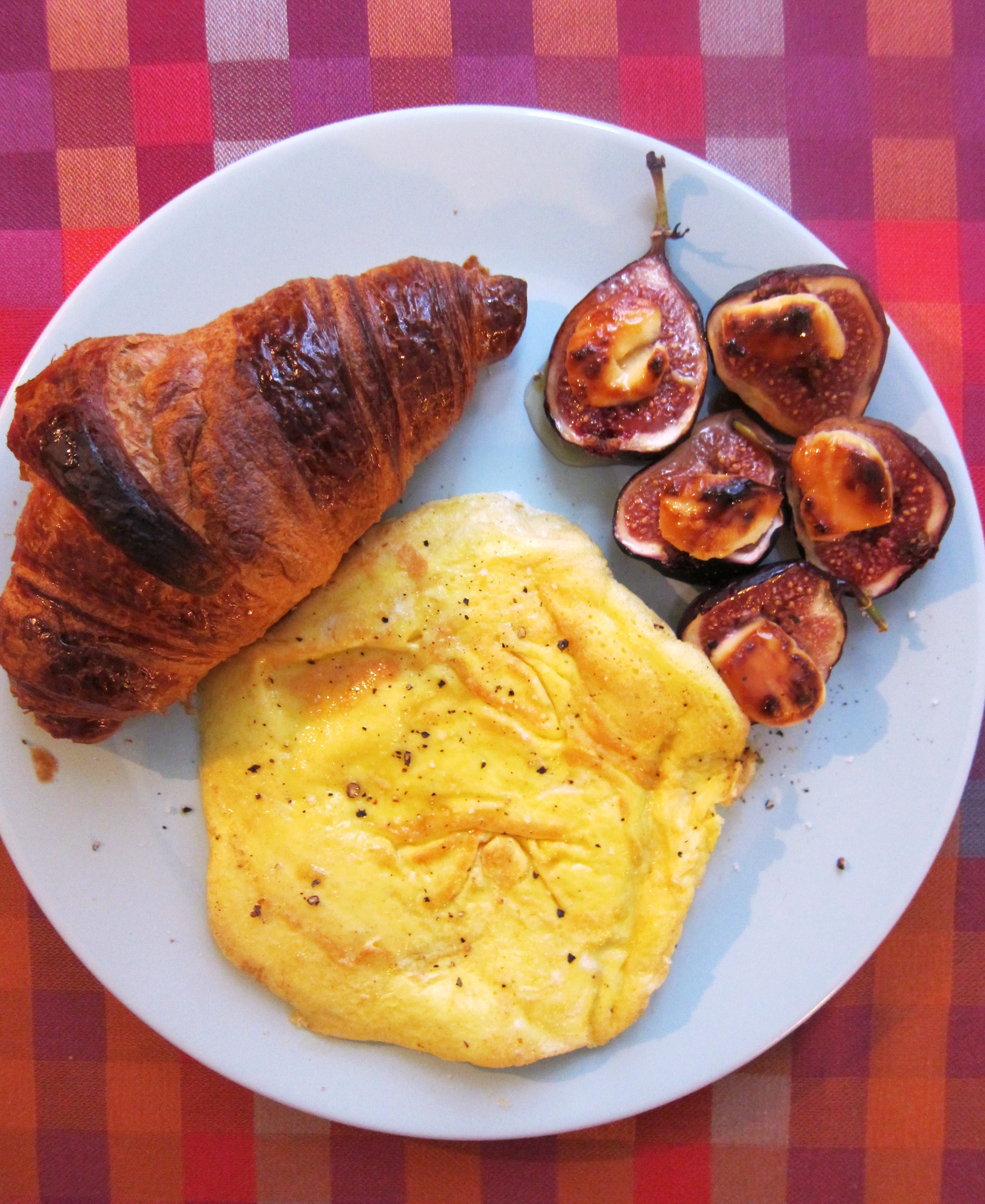
So I will be economical with my words, and just say this: MAKE THIS OMELETTE. It might just be the best one you’ve ever had. It’s filled with clusters of air bubbles that crackle and melt in your mouth – the kind of food that makes you involuntarily close your eyes between bites. Like women do in yogurt commercials.

Oh and the figs? They will sucker punch you into a euphoric haze. So, yeah, make those too.

Well. It was nice checking in with you – but if you don’t mind, I’m going to go back to drinking lemon tea and watching Timothy Olyphant in a cowboy hat.

Souffléed Omelette with Honeyed Figs (serves 1) – inspired by Luisa Weiss’ My Berlin Kitchen

omelette with honeyed figs

  • 3 eggs divided
  • 1 tbsp. cold butter 
  • Salt and freshly ground pepper

1) Divide eggs, putting whites into a medium bowl and yolks into a small bowl. Season egg yolks to taste with salt and freshly ground pepper, mix together with a fork, and set aside.

fig omelette 001

2) Beat egg whites with a whisk until soft peaks form. Fold egg whites gently into egg-yolk mixture until combined and set aside.

whipped egg whites

3) Melt butter in a cast-iron pan on medium heat. When the butter starts to bubble, pour egg mixture into skillet and spread evenly in pan. Cook omelette, gently shaking skillet over heat occasionally, until bottom is golden, 2-3 minutes. Loosen omelette and flip it onto the other side. Cook covered for an additional 2 minutes or until center in just set. Serve straight away.

(Note: another option is to fold the omelette into a half-moon after the first 2 minutes of cooking, then pop it into a 350°F oven to finish. You can also add grated cheese, chives, etc to the beaten egg yolks if you wish.)

For the Honeyed Figs:

  • 2- 3 fresh figs
  • 1 Tbsp honey
  • about 2 Tsbp goat’s cheese

Set the oven to 400°F. Wash and halve the figs. Lay in a roasting pan, cut-side up and drizzle with the honey. Add a dollop of goat’s cheese onto each fig. Place into preheated oven and bake for 6-8 minutes. Set the oven to broil and bake the figs for an additional 30 seconds or until the cheese is bubbling and golden.

The Deep Freeze

I fully acknowledge that talking about the weather is best left for encounters at the water cooler, in the elevator, on the sidewalk with that neighbor you only see twice a year – situations where there’s a mutual understanding that you’re both just filling conversational space with a topic that, while effortless to discuss, can be pretty dull.

But.

It has been one billion degrees below zero this week, and that kind of cold does all sorts of crazy to you. In times like these, talking about the weather becomes an integral part of social interaction, more along the lines of communal therapy than mundane chit chat.

Yes, it’s January. In Canada. In QUEBEC – land of the winter Carnaval and Igloofest. We weirdos have a tradition of celebrating the cold. We even have a formally appointed mascot. But this cold snap has tested our resilience. With temperatures at –40 C, cars seized, eyelashes froze, pipes burst. News reports reminded us, quite aggressively, that exposed skin would freeze in 10 minutes and that neglecting to reduce our energy consumption would cause blackouts.

It’s been brutal.

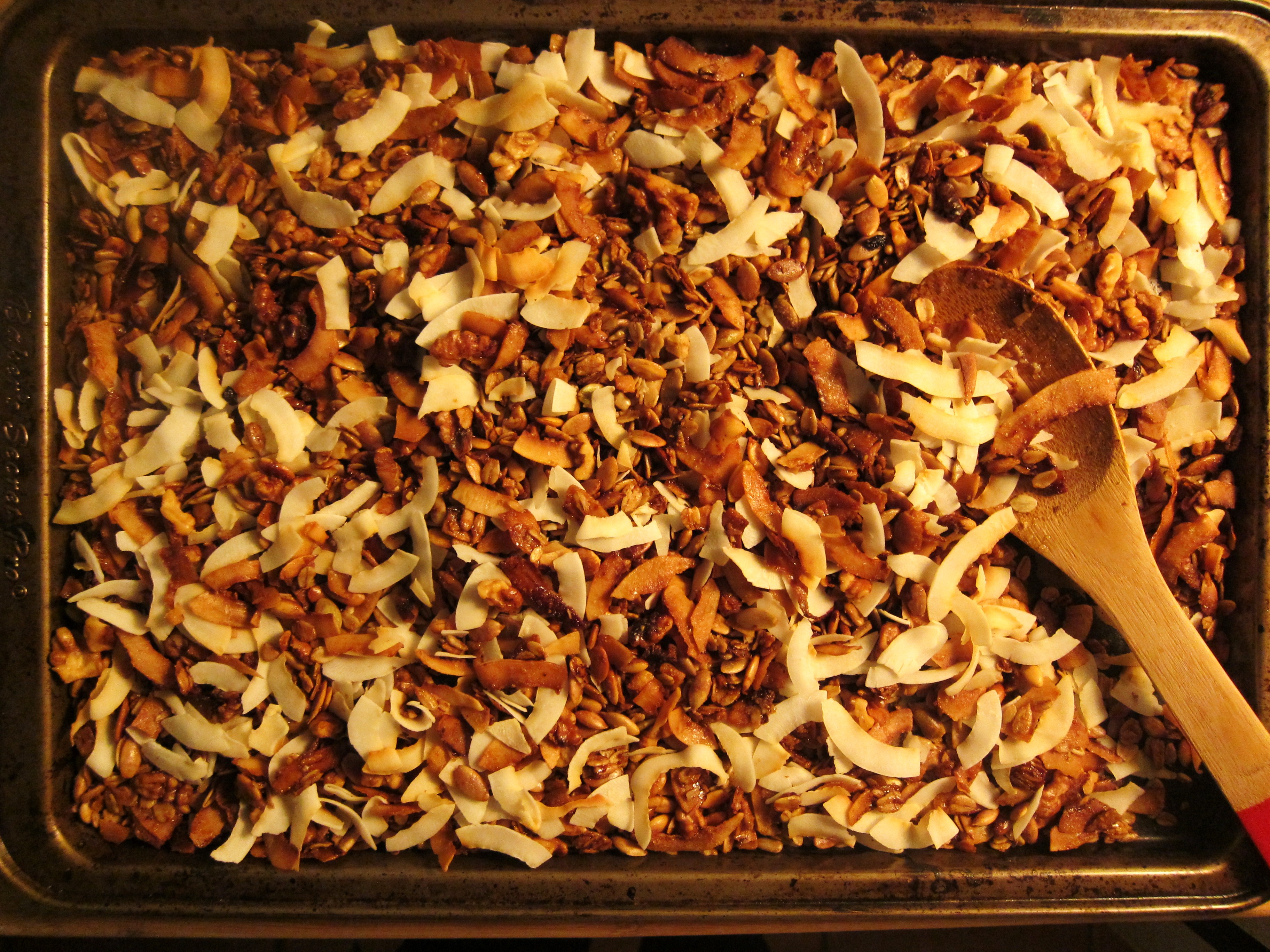
There is one thing, though, that comforts me – and that is knowing that there is a hefty batch of granola on the middle rack of the oven, slowly toasting itself into golden oblivion. Not just any granola. This granola:

Baked granola

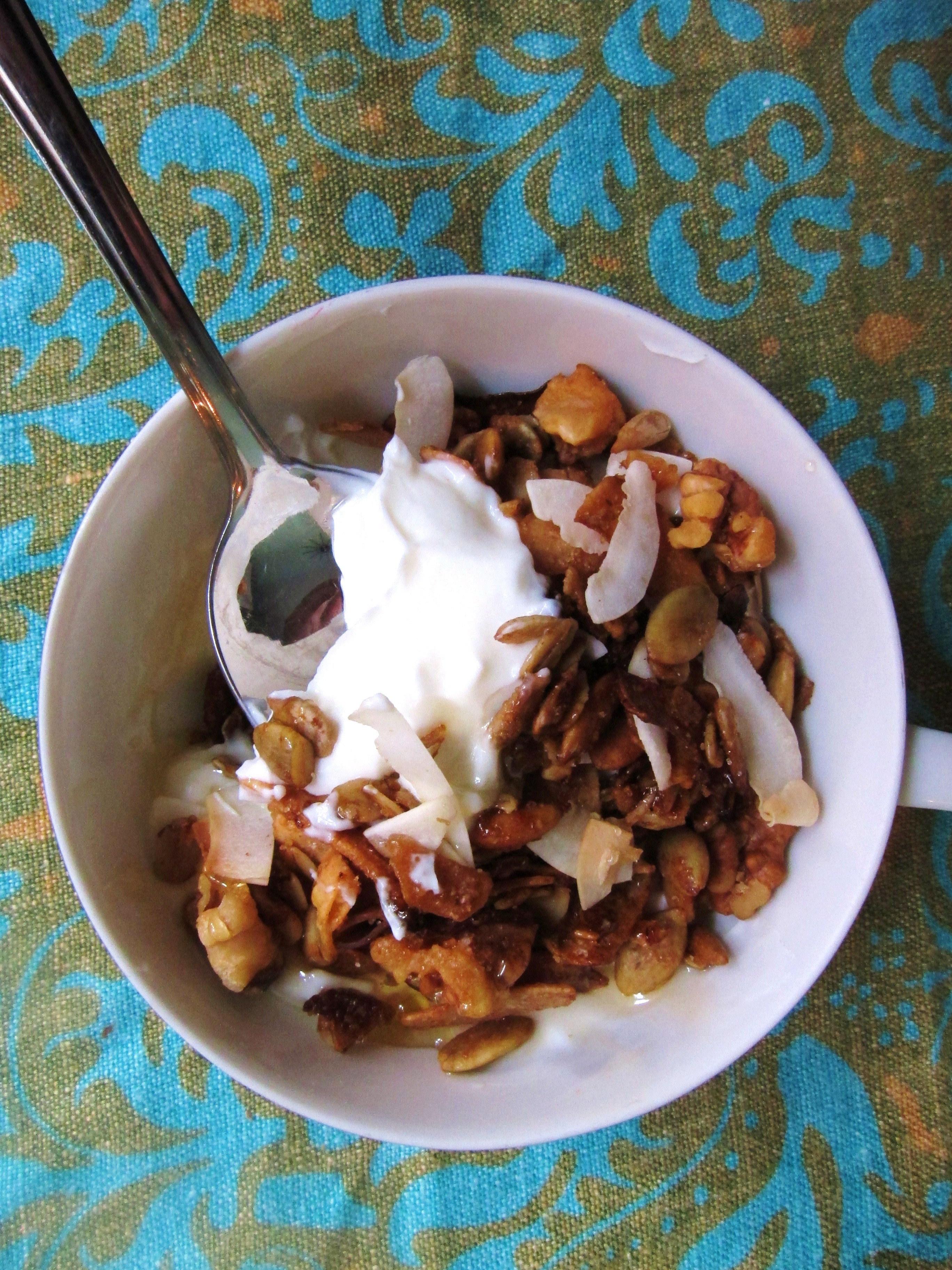
I’m not a cereal person by nature, but this granola has completely bewitched me. I forgot about the cold, the snow, the icy side-walks and harsh winds. With the hot scent of brown sugar, pumpkin seeds and toasted coconut emanating from the oven, it could’ve been the zombie apocalypse out there and I wouldn’t have noticed.

Granola & yogurt

Toasted Olive Oil and Maple Granola (makes about 4.5 cups) – adapted from Nekisia Davis’ recipe featured on Food 52

  • 1 1/2 cups old-fashioned rolled oats
  • 1/2 cup raw pumpkin seeds, hulled
  • 1/2 cup raw sunflower seeds, hulled
  • 1/2 cup unsweetened coconut chips
  • 1/2 cup raw walnuts, coarsely chopped (or pecans, almonds)
  • 1/4 cup pure maple syrup
  • 1/4 cup extra-virgin olive oil
  • 1/4 cup packed light-brown sugar
  • 1 tsp coarse salt

Heat oven to 300° F degrees.

Put oats, pumpkin seeds, sunflower seeds, coconut, walnuts, syrup, olive oil, sugar, and 1 teaspoon salt in a large bowl and mix until well combined. Spread granola mixture in an even layer on a rimmed baking sheet. Transfer to oven and bake, stirring every 10 minutes, until granola is toasted (about 25-30 minutes).

Remove granola from oven. Let cool completely before serving or storing. Can be stored in an airtight container for up to 1 month.

Note: I added a few more coconut flakes for the last 5 minutes of baking to lighten up the colour.

Granola & yogurt

Winterism & amateur athleticism

Nothing, absolutely nothing, makes me feel frumpier than winter.

Sure, for the first appearances of snow, a handful of us are possessed (Exorcist-style) with the bright-eyed, bushy-tailed enthusiasm of children, enchanted by the soft flakes that tickle our noses and crunch delightfully under our feet. “Let it snow!”, we say, grinning like idiots as we make snow angels and throw snowballs at each other in the street.

Ultimately, though, the romance wears thin by January, when we realise that we aren’t kids anymore and have responsibilities, including, but not limited to: shoveling the walkway, commuting to work, running errands, getting to appointments and classes and other scheduled things (all to be done during the snowstorm of the century, no less). At this point, I’m just barely holding on to the whimsical notion that snow is lovely and magical, an effort unaided by the fact that I’ve been wearing the same shapeless coat, clunky boots and “aw, did-your-grandma-knit-that-for-you?” hat for weeks now, making me feel like an over-packed duffel bag forgotten on the airport conveyor belt.

Shovelling in January

Bleurk.

My goal for January? To cultivate feelings opposite from those oozing from this photo.

Anti-frump goal no.1: indoor swimming

Now, to the uninitiated (me), this activity does not come without mixed feelings. Deciding to squeeze into a bathing suit in the dead of winter and trek through snow to the pool defies all logic; it feels like you’re missing a beat on the evolutionary trajectory. You’re not supposed to be swimming when it’s minus 20 C, dummy. To make matters worse, I hadn’t been to an indoor pool since elementary school, for swimming classes that I remember being nothing more than a series of recurring ear infections and an exercise in chlorinated-water ingestion. From that point on, I was never really drawn to swimming as a serious activity, occupying myself instead with the feat of making vortexes by running around our backyard above-ground and knocking my brother over the head with big foam pool noodles. As an adult, pool activities never involved anything more rigorous than floating on inflatable lounge chairs and drinking cocktails. These were scenarios devoid of hair-tearing bathing caps and wax earplugs. No “competitive-cut” bathing suits here, thank you very much.

However, I recognize that getting older means that you’re body starts to get creaky and achy unless you do something about it. And since I have yet to find a gym that doesn’t feel like a purgatorial dungeon, swimming has become a reasonable alternative.

The beginnings were rough. After the first few laps, I felt like I was going to have a heart attack, all the while revisiting my childhood memories of ingesting the contents of the pool and getting water lodged in my ears. Why? Why would anyone do this? But soon after my first swim, I discovered the pay-off. Once you’re done flailing around in the water and you’re stepping out of the changing room and onto the street, you feel like the sexiest person alive. You feel like a full-on, miracle-performing superhero.

Another thing you feel is how hungry you are. All of that thrashing around to keep your head above water makes you very, very hungry – though interestingly, you’re not seduced by burgers or take-out Chinese food or any other highly caloric, heavy fare. In fact, all you want is salad. A big mother of a salad. But it’s cold outside, so you still want something soothing and comforting – which leads us to the simple compromise below. Veggie-centric, but also warm and creamy, this salad makes you feel rewarded for your athletic feat, conveniently distracting you from the leftover pool water swishing in your ear.

Carrot, Beet & Tahini salad

Carrot, Beet & Tahini Salad (serves 2) -adapted from Sprouted Kitchen

  • 1/2 Tbsp. butter
  • 2 Tbsp. extra virgin olive oil
  • 2 large beets, roasted and peeled, cut into ¼” pieces
  • 2-3 carrots, peeled into strips
  • sea salt + freshly cracked pepper
  • 1 tsp. honey
  • 3 Tbsp. white wine vinegar
  • 2 Tbsp. tahini
  • 1 Tbsp. lemon juice
  • 1/2 tsp. ground cumin
  • 12 cups mixed salad greens
  • 2 Tbsp. toasted sesame seeds, white or black or mixed

***if you’ve got some chickpeas hanging around, toss those into the pan too.

Melt the butter in the olive oil in a pan over medium-high heat. Add the carrots and beets and season with salt and pepper. Cook over moderate heat, stirring once or twice, until the carrots are crisp-tender, about 5 minutes. Add the honey and 2 tablespoons of the vinegar and cook over moderate heat, stirring occasionally, until tender and lightly glazed, 2 minutes. Transfer the vegetables to a bowl to cool.

Whisk the remaining tablespoon of vinegar, tahini and lemon juice into the skillet along with the cumin.

Toss the baby lettuces with a light coating of the tahini dressing. Plate the greens and top with the carrots, beets and sprinkle the sesame seeds. Serve straight away.

Carrot, Beet & Tahini Salad

Surviving Christmas dinner

Christmas dinner for 10, survived. But I’m not going to lie – the day after its execution, when I first sat down to write this, I had a knocker of a headache and pretty much just stared at the screen, mouth-breathing. I’m glad to have had these couple of days to step back and regroup.

So here we are, dear readers, on December 29th; I come to you with a sense of calm and sanity that I was unable to muster three days ago when the cooking parade was over and the kitchen looked like it had the worst hangover of its life. All I wanted to do was drink coffee and nap and watch bad movies until I felt functional again.

If nothing else, it was an interesting exercise in love and motivation – from the early-morning grocery shopping marathon, to the chopping, zesting, de-seeding, roasting, whipping, cocktail-shaking and family-wrangling – I have a new-found appreciation for the people who do this every holiday. People with kids, full-time jobs, partners…extra-curriculars. People who spend days, back-to-back, confined in their kitchen cube, but still manage to look like Doris Day when they set it all out on the table, maintaining polite conversation with their guests and smiling pleasantly throughout. You guys rule. Cha-peau!

That said, when you’re doing something out of love, the hard work is worth it. You might be a little worse for wear (box-grater wounds, oil burns, mental collapse) but you’ll recover. Plus, when your grandmother eats your food, puts her hand on your shoulder and very gently calls you “Brava”, all the bad melts away.

—–

Now since it’s almost New Year’s, I thought it’d be a good idea to lay out some (simple, sanity-friendly) recipes that you might find useful for your NYE entertaining. From the menu posted here, I’ve extracted a few delicious little things that would fit an end of year schmooze – whether you’re hosting for two, or a dozen (or even if you’re home sick and entertaining a party of one) – here are some tasty treats to say “Au revoir, 2012” and “Oh well, hello there, handsome 2013”.

Satsuma & Pomegranate Campari Cocktails – serves 6-8 (adapted from Baker’s Royale)

juiced satsuma

  • 4 parts satsuma (about 12), freshly squeezed, sieved and chilled*
  • 2 parts pomegranate juice**, freshly pressed, sieved and chilled
  • 2 parts Campari
  • 1 part white vermouth
  • fresh ice
  • strands of orange zest (optional)

*I know, I know…juicing fruit seems like a lot of work. But once you get into the swing of it, it ain’t that bad. And it makes the drinks so, so much better. Trust me on this one. Put on some music and karaoke your way through it if you want to. It’ll be worth it.

**Tips to de-seed and juice a pomegranate:

1) Remove any light-coloured clothing and put on an apron – things might get a little messy (à la slasher film).

2) Cut the pomegranate in half, hold it cut-side down with both hands over a large bowl and gently press the center, lifting the sides up slightly. This will help release the seeds from the pulp.

3) Holding the pomegranate over the bowl with one hand, cut-side down, firmly whack the skin-side (facing up, towards you) with the back of a wooden spoon until all of the seeds have fallen out into your hand and the bowl. Remove any little bits of pulp that may have found their way into the bowl (there shouldn’t be many).

4) Reserve about 1/4 of the seeds for serving. Pour the remaining seeds into a food processor and liquefy. Push the juice through a sieve to dispose of the tougher bits (the actual seeds within the juice-filled pod). Chill before use.

Serving the cocktail:

1) Divide the reserved pomegranate pods and orange zest strands evenly between 6-8 glasses (martini glasses or champagne coupes are pretty dapper).

2) Fill a cocktail shaker 1/4 full with ice.

3) Pour in the juices, the Campari and the vermouth. Shake until combined.

4) Serve in the prepared glasses. Bottoms up, baby.

pomegranate cocktail3

Persimmon and pear and caprese toasts (makes approx. 20 canapés) – adapted from Joy the Baker

  • 1 semi-firm persimmon, sliced + each slice cut into quarters
  • 1 medium pear (Bartlett or Anjou), sliced
  • 4-5 small bocconcini, sliced
  • 1 baguette, sliced thinly
  • 1/4 cup pesto (best way to revive frozen pesto from the summer)
  • basalmic vinegar (the best you can afford)
  • olive oil for brushing
  • fleur de sel and freshly cracked black pepper

persimmon toats detail

Directions

1) Preheat the oven to 350° F. Lay baguette slices on a pizza tray or baking sheet; brush with olive oil and bake for about 8 minutes, or until golden brown. Set aside to cool (if you want to do these ahead, conserve them in a brown paper bag until use).

2) Put pesto in a small bowl and brush onto the toasts. Next, toss the bocconcini slices into the bowl and stir to coat the cheese with pesto.

3) Arrange toasts on a serving platter and layer with a slice of persimmon, pear and bocconcini. Sprinkle with fleur de sel and cracked pepper. Finish with a gentle drizzle of balsamic vinegar*

(*if you have the time, it’s worth reducing the vinegar by heating it in a pan until it becomes a bit syrupy.)

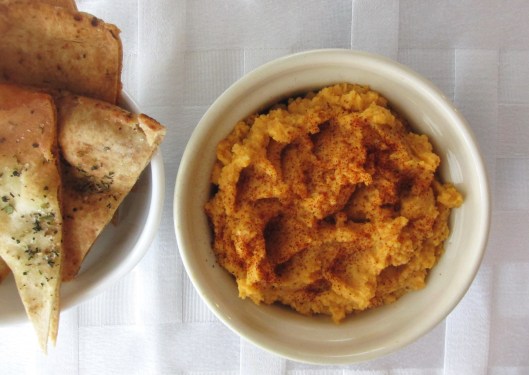
Smoky sweet potato hummus – adapted from Blissful Eats

smokey hummus

Makes 4 cups

  • 1 pound sweet potatoes (about 2 medium)
  • 1 can chickpeas, drained and rinsed
  • 1 tsp chopped chipotle chili, canned in adobo sauce
  • 1 garlic clove, chopped
  • 2 Tbsp fresh lime juice
  • 2 Tbsp olive oil
  • 2 Tbsp tahini
  • coarse sea salt and freshly ground pepper

Directions:

Pre-heat the oven to 350° F.

Pierce potatoes several times with a fork; place on a foil lined baking sheet.  Bake until tender (about 45 mins).  Cool slightly, then peel and add to the bowl of a food processor.  Add chickpeas, lime juice, tahini, olive oil, chipotle and garlic.  Purée until smooth, adding up to 2 tablespoons of water if necessary. Season with salt and pepper. Garnish with a drizzle of olive oil and smoked paprika before serving.

Pita chips (makes about 60 chips)

  • 2 bags of pita bread (whole wheat and/or white)
  • herbes de Provence
  • olive oil
  • fleur de sel

Directions

1) Preheat the oven to 350° F.

3) Place pita slices on a pizza tray or baking sheet; brush with olive oil and sprinkle with herbes de Provence and fleur de sel. Bake for about 6 minutes, or until golden brown. Allow to cool and reserve in brown paper bags. Serve with smoky sweet potato hummus.

Winter holiday

You have no idea.

This holiday makes me lose my marbles. It causes the synapses in my brain to spew chemicals in the shape of sugar plums and sleigh-bells, as evidenced by my (cat-lady?) decor choices as of late: there are paper snowflakes and twinkle lights at the office; glass ornaments dangling off house plants; a bushy wreath on the front door and friends’ Christmas cards stringed across the doorway of my kitchen. I don’t care how un-cool it all looks.

I

LOVE

THIS

HOLIDAY.

In my family, Christmas insanity reaches its crescendo in the kitchen. It’s one of the genetic hazards of having Italian blood coursing through your veins. The amount of baking and cooking that goes on between the 23rd to the 26th of December is fairly ridiculous, but I can’t imagine spending a Christmas without an army of cookie sheets, a metric ton of butter, and all those bags of sugar, dark chocolate and nonpareils. It’s special. It’s magical. And despite the madness (and sweating and finger-burning and swearing), I wouldn’t have it any other way.

Over the next couple of days, I will need to remind myself of this last point – repeatedly – as I prepare to make dinner for my family on the 25th. Christmas dinner. THE dinner. It might be an epic disaster, but I’m willing to risk it for the chance to knock grandma’s socks off. Here it is, in bullet-point form:

Christmas dinner for 10

  • Satsuma and pomegranate Campari cocktails
  • Beet root chips with fennel seeds

—–

  • Persimmon/pear/bocconcini caprese toasts
  • Smoky sweet potato hummus with toasted pita chips
  • Panko-crusted artichokes

—–

  • Butternut squash and apricot soup with pistachios
  • Frisée & mint salad with pomegranate

—–

  • Turkey with rosemary butter and gravy
  • Herbed bread stuffing
  • Potato and parsnip purée
  • Brussel sprouts with chestnuts, leeks and bacon
  • Baked lemon and thyme mushrooms
  • Cranberry compote with orange, ginger and dates

—–

  • Spice cake with lemon curd filling and cloud frosting

(fingers crossed it all goes off without a hitch…)

Happy holidays, lovely readers. See you all again here soon ♥