• Home
  • About

julia chews the fat

julia chews the fat

Category Archives: Lunch & Dinner

Wanderlust + the contents of my fridge

30 Wednesday May 2012

Posted by julia chews the fat in Lunch & Dinner

≈ 4 Comments

In a couple of days, I’ll be flitting off to Barcelona for a week. Being a bit of a nerd about trip-planning, I’d assembled a laundry list of things that needed to be taken care of pre-voyage: Sunscreen? Check. Spanish/Catalan phrasebook? Check. EU adaptor plug? Check. Pickpocket-proof fanny pack? Check. That’s right – fanny pack. A beige one, no less. Yes, I am severely aware that my travel gear is more Angela Landsbury than Gisèle Bunschen. But I’m sure my travel companion (one, younger brother) will appreciate that I left the PG-13 bathing suit at home. Besides, I’m just looking forward to hanging out with baby brother, surrounded by tapas, Gaudi mosaics and the effortless “th” sound that makes “zapatas” sound like “thapatas”.

But before any of that can happen, there are still a few things that need to be tended to before the fanny pack even makes its way into the suitcase. Ranking high on the trip prep list has been the task of figuring out what to do with the contents of my fridge. Being a consummate over-shopper when it comes to food (see the full confession here), this week I’ve had to deal with a fridge that’s been stocked for a family of six – which is a problem because the inhabitants of this apartment consist of me and my plants: Edgar, Lucinda, Phyllis, Thelonius III and Mike, and they, like waif supermodels, survive off water.

Over the last few days, I’ve had to get serious about the perishable foodstuffs in my kitchen to avoid coming home to a family of rotting bananas and a flock of fruit flies. So, dear readers, the recipe below is one of the many meals this week inspired by my need to make use of the veg and dairy and meat in my fridge before getting on the airplane and making my way through the earmarked pages of my Spanish phrasebook.

Looking forward to finding you here again upon my return from the Iberian Peninsula – the place that brought us flamenco, chorizo and Antonio Bandaras. Muchas grathias for all three.

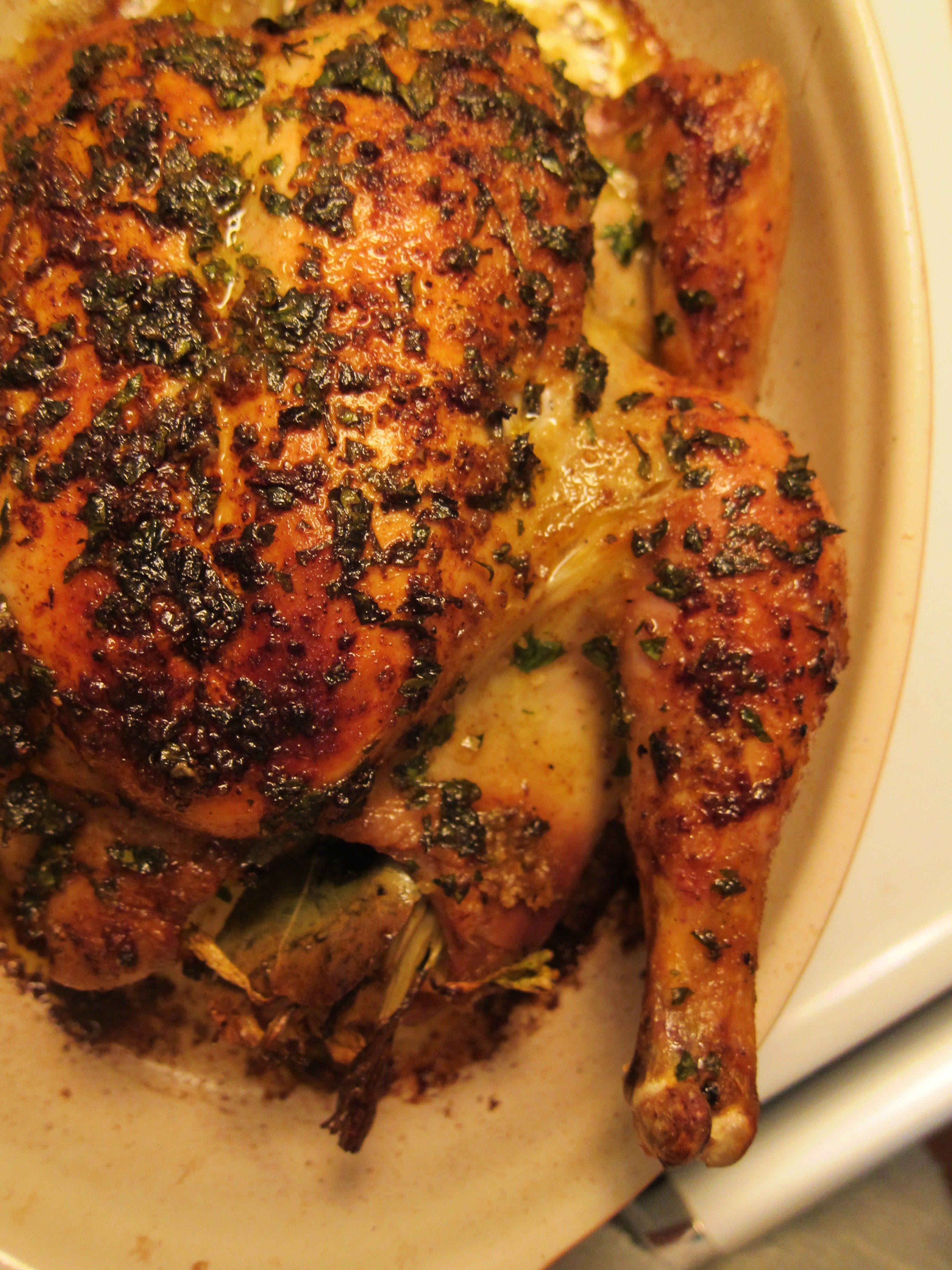
Roast Chicken with Fennel Gratin
For the chicken:

  • 3 lb whole chicken (better: organic or free range), giblets removed
  • 1 lemon, cut in half
  • 3 cloves of garlic, peeled and crushed
  • 1 tbsp butter
  • 4 sprigs of fresh thyme, chopped (+ 3 sprigs extra, intact)
  • 2 sprigs of fresh rosemary, chopped (+ 1 sprig extra, intact)
  • Sea salt and pepper

Rinse the chicken under cold water and pat dry. Insert garlic, lemon and sprigs of thyme and rosemary in the cavity of the bird. If you have kitchen twine, tie the legs together to prevent the lot from falling out and to keep the leg meat moist. Give the bird a little massage of butter. Sprinkle the chopped herbs all over the bird, and add a generous amount of salt and freshly ground pepper. Let chicken sit out, covered, until it reaches room temperature (about 40 minutes).

Preheat the oven to 450°F. Keep yourself occupied for a little while, to let the oven heat up properly.

Place the bird in a roasting pan. Immediately reduce oven temperature to 350°F and roast in the oven for about an hour or until a meat thermometer reads 165°F when inserted into the breast of the chicken and the juices run clear.

*Note: a good rule of thumb to gauge cooking time for poultry is 20 minutes per pound at 350°F.

For the gratin (adapted from Saveur):

Serves 2-3 as a side-dish

  • 1 small fennel bulb, sliced; some frilly green bits reserved
  • 1 large onion, sliced
  • 1/2 cup of cream (15% or 35%)
  • 1/3 cup Gruyère, grated
  • 1/4 cup white wine or vermouth
  • 1 tbsp butter
  • 1 tbsp flour
  • freshly grated nutmeg, to taste
  • olive oil
  • sea salt and pepper

Toss onion and fennel (including frilly bits) in a small baking dish with a pinch of salt and pepper.
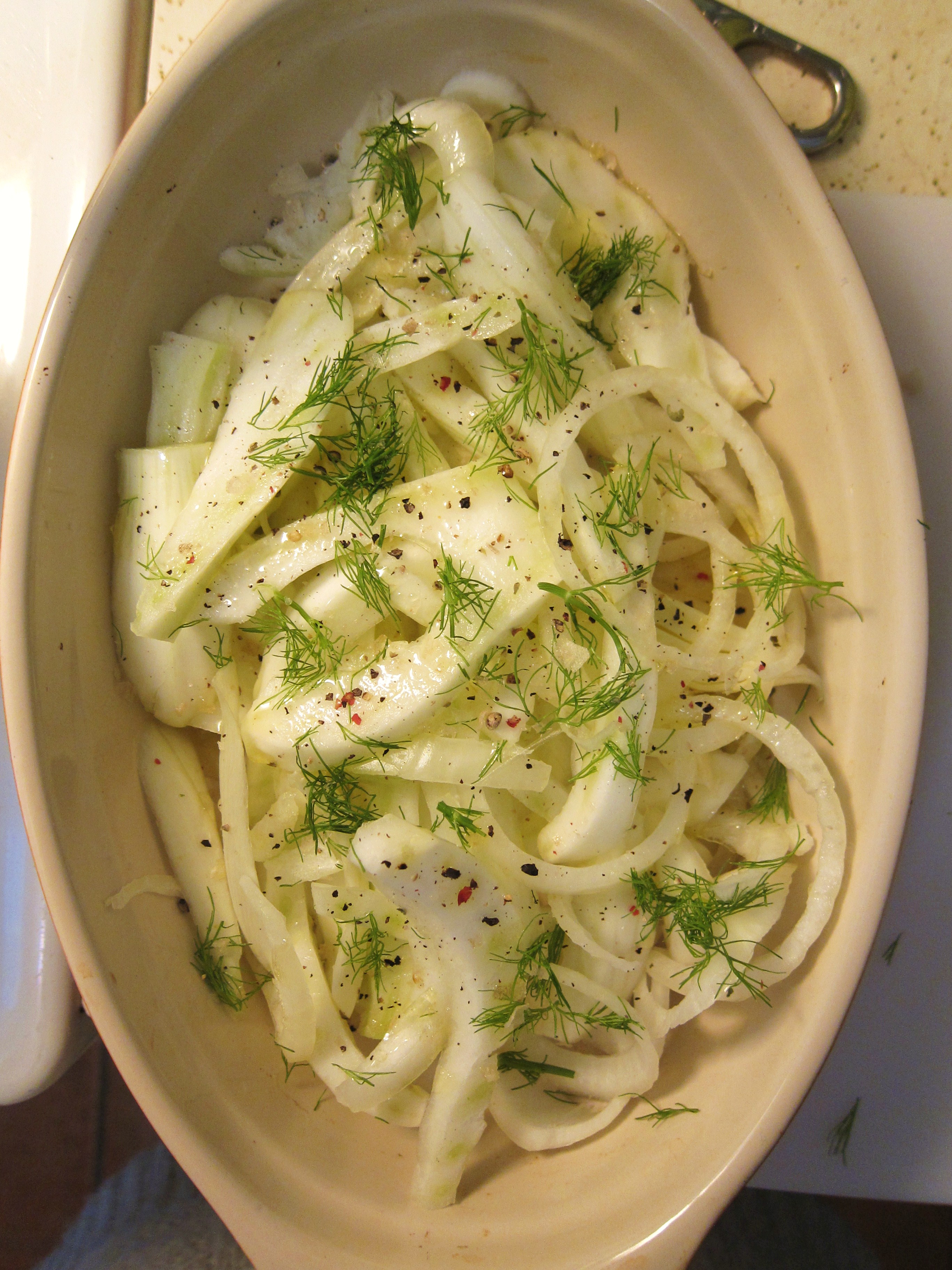
Place in the oven alongside the chicken and let bake for about 15 minutes, until lightly browned. Remove from oven and set aside.

When you’ve removed the chicken from the oven, set the oven to broil.

Heat butter in a small saucepan over medium-high heat until it starts to foam. Add flour, and cook, stirring, for about 1 minute. Pour in the wine, then the cream and cook, stirring, until thickened (about 2 minutes). Season with salt, pepper, and grated nutmeg.

Pour the sauce over the onions and fennel and grate a thin layer of Gruyère over the top. Place in the oven and broil for about 2 minutes.

Share this:

  • Tweet
  • Share on Tumblr
Like Loading...

Nonna’s Meatballs (Polpette)

22 Tuesday May 2012

Posted by julia chews the fat in Cooking For Your Peeps, Cooking with Nonna, Lunch & Dinner

≈ 4 Comments

When my cousin returned to North America after spending several years away in Taiwan, she was asked what she’d like to have at her repatriation dinner. Without skipping a beat, she uttered: “Grandma’s meatballs. I want Grandma’s meatballs.”

It made sense – anyone who’s had them knows the effect that they can have on people. I’ve even known vegetarians to try them. In fact, I wouldn’t be surprised if they’d secretly trade their first-born for one.

Like virtually everything that has come out of Nonna’s kitchen, her meatballs are straightforward and to-the-point; the recipe never changes and you can almost count the number of ingredients on one hand. These meatballs don’t mess around, people. I recommend that you respond in kind, resisting the urge to mess around with them by adding or subtracting components. This is not your opportunity to, say, make foie gras or quinoa-ball concoctions. Any attempt to get inventive would result in a polite, yet firm, “tsk” from Nonna, reminding you that some recipes are better left intact.

Like any good family recipe, this one has a secret weapon. I’d love to tell you that it’s the amore that’s put in it or that there’s some special, ancient rolling technique involved. But really, it’s the veal. It’s all about the veal. Forget everything you learnt about meatballs containing beef. Beef does not belong in this meatball. Trust me.

It’s worth mentioning that the recipe included here is actually a variation of Nonna’s decades-old recipe. Her version requires that the meatballs be cooked slowly in homemade tomato sauce. But on this given day, circumstances (and more specifically, time) dictated that we bake them in the oven. They are not identical to Nonna’s*, but they still contain the traditional ingredients and be absolutely delicious, the only real difference being that they will have a crispy exterior.

(*if you want them to be exactly like Nonna’s, add the raw meatballs to a simmering pot of tomato sauce to cook them through – gently and slowly. Cooking time will vary depending on the size of the meatballs.)

Polpette

  • 1/2 kg minced pork
  • 1 kg minced veal
  • 4 cloves of garlic, minced
  • a handful of parsley, minced
  • 3/4 cup of breadcrumbs
  • 3 eggs, beaten
  • 1 1/2 tsp salt + 1/2 tsp freshly ground black pepper

Directions

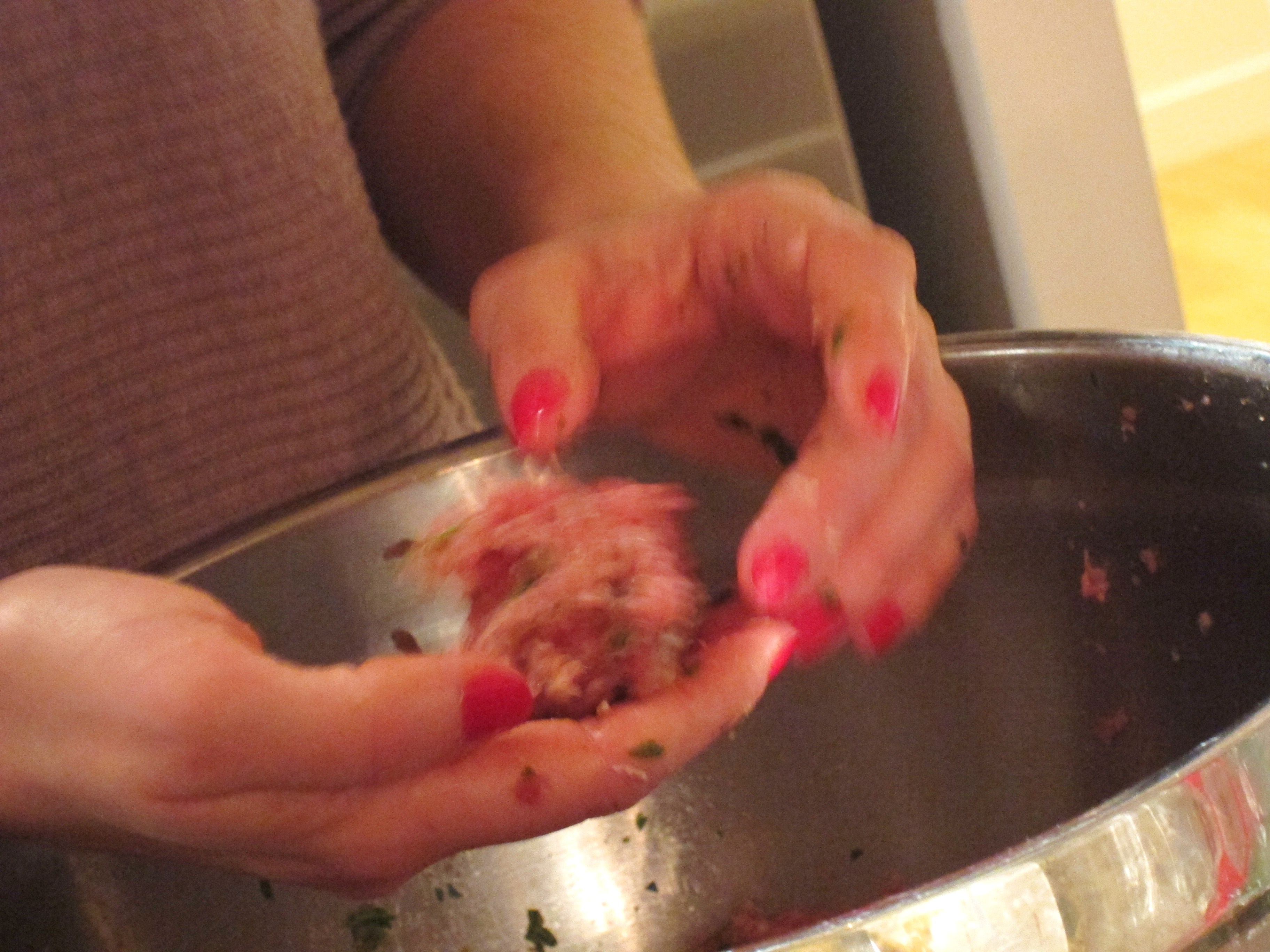
Preheat oven to 375°F. Place meat in a large bowl. Add garlic, parsley, salt & pepper; mix into meat. Add breadcrumbs and eggs; mix until combined and until ingredients are evenly distributed. Roll into golf ball-sized portions.

Arrange on a parchment-lined cookie sheet and place in the preheated oven. Bake for about 10-12 minutes, or until cooked through, turning them once halfway through the cooking process.

Note: these delightful little things freeze really well. Simply place cooked meatballs on a parchment-lined cookie sheet and freeze, later placing them in freezer bags or airtight containers equipped for the freezer.

Share this:

  • Tweet
  • Share on Tumblr
Like Loading...

A true lady – and duck

03 Thursday May 2012

Posted by julia chews the fat in Lunch & Dinner, The Basics

≈ 7 Comments

It started with the realisation that I’d spent half the day with my watch on upside down. And the secondary realisation that I had probably consulted it a few times since putting it on. These are moments when I feel lucky not to have the responsibility of taking care of pets and small children. I can easily imagine my morning starting with a dog in a diaper or a child frolicking in the garden on a leash.

I’m not generally a scatterbrain, but I’ve been abnormally distracted these past few days, because this week marks a milestone birthday – one that both petrifies and thrills me. And while a true lady never divulges her age, I can tell you that the week I was born, the number one country music hit in Canada was “Same Ole Me” by George Jones.

Did you really just look that up? Impressive. You win a big, fat plate of duck.

There’s something vaguely regal about duck. It’s got pomp. It’s got sass. And it’s the kind of thing I pick up when I’m feeling a bit posh. If I’m feeling EXTRA posh, I’ll also pick up a bottle of port to accompany my duck, in the spirit of “one splash for the pot, and one splash for me”. On birthdays, a dish of duck and port is a good way to highlight another year that has passed – and to usher in all the ones to come. *Cin cin*

Birthday Duck (serves 2)

  • 2 duck legs (thighs)
  • 1/2 cup chicken stock
  • 1/2 cup of port
  • one carrot, diced
  • one stalk of celery, diced
  • one small onion, diced
  • 3 cloves of garlic, chopped
  • one bay leaf
  • sea salt & black pepper

Directions

Heat the oven to 325°F. Put a cast-iron pan on the stove on medium-high heat. While that’s heating up, prepare your duck by patting it dry with paper towel and seasoning liberally with sea salt and freshly ground pepper. When the skillet is hot, place duck legs in the pan and sear for about 5 minutes on each side. Remove from pan and place in an oven-proof casserole dish. Pour off most of the fat, leaving behind about a tablespoon in the pan.

With the pan on medium heat, add the onion, garlic, carrot and celery. Sauté a couple of minutes until softened, then add the port. Allow to reduce for about 5 minutes, then add the stock and bay leaf. Reduce again for about 10 minutes.

Pour the port mixture over the duck and cover loosely with foil. Allow to braise for 30-45 minutes, checking from time to time to make sure that there’s still braising liquid in the dish. The duck is ready when the meat can be easily pulled away from the bone.

Share this:

  • Tweet
  • Share on Tumblr
Like Loading...

Easter weekend + one piñata-fail

16 Monday Apr 2012

Posted by julia chews the fat in Cooking For Your Peeps, Lunch & Dinner

≈ 3 Comments

When it comes to holidays, I somehow always manage to romanticize my ability at crafting. In reality, though, the closest thing to crafting that I’ve ever (successfully) done is read Amy Sedaris’, “Simple Times” front to back, a half-dozen times.

Easter is particularly problematic at it seems to light up the part of my brain that believes I’m a crafter, rattling awake after a long post-Christmas dormancy period. One Easter, a couple of years ago, I was hell-bent on making homemade marshmallows, imagining all of the neat thematic shapes I would make (Chicks! Baby bunnies! Oh, how marvelous and squishy they will be!). I looked up recipes, bought a candy thermometer, and kept an eye out for bunny-shaped cookie cutters. Thankfully, I have enough Anglo-Saxon pragmatism coursing through my veins (thanks, Dad) to set me straight, reminding me that DIY projects involving boiling candy can unleash a Pandora’s box of nightmarish mishaps, especially for the uninitiated. So while my soft side was under the spell of an ambrosial marshmallow haze, my sensible side was there to remind me that getting burned by the candy thermometer and smearing of sticky, gelatinous blobs onto everything in sight, including my hair, was probably not all that great.

Notwithstanding the voice of reason, my fantasy of becoming craft-lady extraordinaire still manages to inject itself into plans that are supposed to be easy, lovely and stress-free…

…like that time I decided to make a giant piñata.

This year, right around Easter, it was my goddaughter’s 5th birthday – an occasion for which I was asked to make a piñata for the kids’ party. Being a godmother is a role I take fairly seriously, but if I’m being perfectly honest, it has never extended beyond reading a few stories, making abstract finger-paintings and letting her stay up past her bedtime. I’ve maybe braided her hair. Once. All in all, though, it’s been a pretty laid-back gig. Making her birthday-piñata felt like the next step in my godmother duties. Perhaps not as elaborate as making a horse-drawn carriage and ball gown appear out of thin air, but still.

Now, it goes without saying that I’m the furthest thing from a piñata/papier mâché expert. My mental Roladex is pretty sparse in that department. But I did my homework, consulting Youtube and Pinterest and noting down suggestions made by friends. I bought taffy and ribbon and crêpe paper and a ginormous balloon. THIS GODMOTHER WAS GOING TO MAKE THE BEST EASTER EGG-BIRTHDAY PIÑATA EVER. But I was also recovering from shoulder surgery and could barely tie my shoes. (Clearly, my Anglo-Saxon pragmatism was on holiday. Probably off on a beach, sipping a margarita.)

The details of the piñata-demise are not particularly thrilling, but long story short, the balloon deflated before all the layers had dried and the papier-mâché shell collapsed into a pathetic pile at the bottom of the bathtub. In a sorry attempt to revive it, I slipped in a second balloon and blew it up as quickly as I could. It was like trying to douse a beached whale with little sandcastle-pails filled with water – desperate and ultimately useless (to indulge in some schadenfreude, you can find a photo of it in the slideshow further below). Not wanting to flake on a promise I had made to a 5-year-old, I rushed to the party supply store 20 minutes before closing and bought a dubious-looking, ruffly paper cow with crooked eyes, made in China. Anglo-Saxon pragmatism restored, but craft-romanticism crushed.

—–

Luckily, there was Easter dinner the next day to distract me from the wreckage and restore faith in my ability to make things – at least of the culinary variety. While my brother, dad and I were in charge of salads and sides, mom was at the helm constructing a handsome lasagna, several frilly layers high. While it’s not something we typically have at Easter, the lamb seemed quite pleased to be curled up against that hot mess of béchamel and noodles.

You may want to do the same.

Mamma’s Easter Lasagna

1 package oven ready lasagna pasta (375 grams or 3/4 lb)
1 cup water
1 cup grated mozzarella
1/2 cup grated Parmigiano-Reggiano

Meat Sauce

3 tablespoons extra virgin oil
1 onion, finely chopped
1 carrot, finely chopped
1 celery stalk, finely chopped
2 large garlic cloves, finely chopped
1 lb minced veal
1/2 lb. minced pork
1/4 cup tomato paste
handful chopped Italian parsley
6 cups canned tomatoes (or better: Nonna’s tomatoes)
Salt and pepper to taste

Heat the oil in a skillet. Add the chopped onions and cook for about 4 minutes. Add the remaining vegetables and half of the chopped garlic. Continue to cook until golden. Stir in the pork, veal, parsley and the remaining chopped garlic. Cook the meat until it is no longer pink and the juices are absorbed, about 10-12 minutes. Stir in the tomato paste. Pour in the tomatoes and simmer until the sauce thickens (40-60 minutes).

Ricotta-Spinach filling:

1 bunch fresh spinach
1 container of ricotta (1 1/2 cups)
1 egg
1 teaspoon salt
1/4 cup grated Parmigiano-Reggiano  (the other 1/4 cup will be used later to sprinkle throughout the layers of lasagna)

Cook the spinach. Drain and wring out as much moisture as possible. Chop the spinach and set aside to cool.

In a bowl, whisk together the ricotta, egg, parmesan, and 1 teaspoon salt. Whisk in the chopped spinach and set aside.

Béchamel sauce:

3 cups hot milk
6 tablespoons butter
6 tablespoons flour
1 bay leaf
pinch of nutmeg
salt to taste

In a medium saucepan, melt 6 tablespoons of butter until foamy and stir in the flour with a whisk (you are making a roux). Continue to stir and allow the flour to cook for about 2 minutes. Gradually pour the hot milk into the roux while continuing to whisk, taking care to stir out any lumps. Bring to a boil. Lower the heat and continue to whisk continuously until the sauce is very smooth. Cook for 3 minutes and remove from the heat.

Assembly 

Preheat oven to 375°F with rack in middle.

Spread a layer of meat sauce to cover the surface of the 9×13 inch baking pan or casserole dish. Pour in 1/2 cup of water (if using the oven ready lasagna). Lay some sheets of lasagne over the sauce; add a layer of meat sauce and a sprinkling of parmesan and mozzarella.

Place a second layer of pasta sheets. Spread some of the spinach-ricotta mixture on top of the noodles. Then add a layer of béchamel sauce.

Repeat with one more layer of pasta/meat sauce and one more layer of pasta/ricotta mixture and finish with a generous layer of béchamel and some grated parmesan. Cover pan with foil and bake 50-60 minutes. Uncover and continue to bake to allow the béchamel to become golden.

This slideshow requires JavaScript.

Share this:

  • Tweet
  • Share on Tumblr
Like Loading...

Back-to-it Minestrone

04 Wednesday Apr 2012

Posted by julia chews the fat in Lunch & Dinner, Soups, Vegetarian

≈ 3 Comments

Three weeks ago to the day, an orthopedic surgeon made three small incisions in my right shoulder to fix a recurring dislocation problem. Since then, there have been things that I’ve temporarily had to bid adieu to, including pantihose, chopsticks, bras, clothes-folding, bed-making, hair-styling, hugging people with both arms and sleeping in any other position than corpse-pose. It’s bewildering that I’ve managed to look remotely presentable this last little while – barring those first few days at the beginning when I looked like something you might find in the recesses of your couch cushions. Luckily, the people in my day-to-day didn’t seem to notice. That, or they’re magnificent liars. I can appreciate either.

Despite feeling like a gimpy three-legged dog over the last couple of weeks, it hasn’t been all bad. In fact, I’ve taught myself some pretty neat tricks, like putting on socks with one hand, applying liquid eye-liner like a lefty and resisting the urge to catch things when I drop them (anthropological note: watching passively as your most beloved piece of porcelain escapes your grip and shatters into a gazillion pieces on the floor is an interesting testament to the strength of human willpower). Equally interesting is the realisation that you will not be able to sweep said shards of porcelain into a dust pan in order to discard them. Human ingenuity dictates that a quick sweep with one’s sock to hide the evidence in the corner of the room will do the trick. That is, until your mother visits with food and casually asks if you need help “tidying up”.

Having relied almost exclusively on the care-packages of a lovingly doting mother and take-out sushi from down the street, the extent of my kitchen activity has involved reheating leftovers and pouring the contents of plastic containers onto plates, which, as you might have guessed, is as enchanting as it sounds.

I recognise that things could have been worse (on all sorts of accounts). But I missed my pots and pans and various kitchen implements. It felt like I hadn’t used them in so long that on any given day they might mobilize and walk out the front door, bereaved and weepy. But this past weekend I reached a recovery milestone: being able to wield a knife and chop things. Hallelujah.

Below, I bring to you the first real thing I’ve made in the last 3 weeks – from beginning to end – in my kitchen, WITH MY OWN TWO HANDS. I may not yet be able to shave my right armpit, but it looks like I can still make a mean minestrone – gimpy arm and all.

Minestrone (serves 4)

  • 1 small onion
  • 1/2 leek, finely chopped (white part only)
  • 2 cloves garlic, finely chopped
  • 1 carrot, diced
  • 1 celery stalk, diced
  • 1 stalk of swiss chard, finely chopped (spinach or kale could be used instead)
  • 1/2 cup white vermouth
  • 1 litre home-made chicken stock
  • 1/2 can crushed tomatoes (or better: 1/2 jar of Nonna’s tomatoes)
  • 1 can cannelli beans (or better: dried beans, soaked overnight & cooked)
  • 1/2 cup small pasta, preferably ditalini (“little thimbles”)
  • a few sprigs of parsley, chopped (fresh basil or thyme also work – just go easy on the thyme)
  • olive oil
  • salt to taste

Optional: fried garlic and pine nuts (to serve)

Directions

Prepare a dutch oven with some olive oil and set on the stove at medium-high. Once the oil starts to get warm, add the onions, leek and garlic sauté until translucent.

Add the carrot and cook for about 2 minutes. Then add the celery and swiss chard and cook for another minute. Pour in the vermouth and stir. Add the crushed tomatoes, parsley, broth and some salt. Give a good stir and reduce the heat to low.

Allow to simmer for about 10 minutes then add the beans and the pasta (cook until al dente). Feel free to add more broth or water if you think it looks too thick (note: you can extend the cooking time to let the flavours settle in a bit more – but don’t add the pasta until the end and be sure to start with more liquid).

Serve with fried garlic and pine nuts and a generous shaving of parmesan.

Share this:

  • Tweet
  • Share on Tumblr
Like Loading...

Chinese tortellini

27 Tuesday Mar 2012

Posted by julia chews the fat in Lunch & Dinner, Soups

≈ 2 Comments

Venus and Jupiter walk into a bar…

There are a few popular legends surrounding the creation of tortellini – three to be exact. But my favourite by far is the one that involves a boozy encounter between Venus and Jupiter and a perverted inn-keeper. I’ll spare you the details, but it’s a fun jaunt through medieval lore via the Interweb. At the very least, it can be a fun story to share with the in-laws at dinner, especially if you sass-up the specifics. If you’re feeling shy, you can rely on this week’s space news to introduce the topic.

While I can’t confirm the true origins of tortellini, I can tell you this: it is not amongst my Nonna’s tried-and-true recipes. In fact, I had never come close to seeing homemade tortellini until I went to Bologna to visit family in 2001, when they were served to me in a soup. (Please note that I’ve just used the words “homemade”, “tortellini” and “Bologna” in the same sentence. Mm hm). The filling was made with two types of meat sourced from the family farm, fresh Parmigiano-Reggiano (Parma being just down the road and all) and herbs grown from the garden. The pasta was made in casa, hand-rolled by a Bolognese mamma; the broth was homemade too – with stock made from the farm’s chickens, no less.

Oh and this was just the starter.

Like any good romantic fling, this one stayed suspended in the pillowy nostalgia of a short-lived, cross-continental escapade. I was happy to look back on it fondly as a moment that could never be replicated, presumably explaining why I’d never attempted making tortellini in the confines of my apartment’s depressingly small kitchenette. There was definitely a fear of making sub-par specimens and, ultimately, popping the rose-coloured bubble of my Bolognese food fling.

There had always been, however, a little dumpling that my mom used to make – something that my Nonna refers to as “Chinese tortellini”. Basically, a gingery meat mixture tucked into a wonton wrapper, served in broth. This has nothing to do with the Bolognese version – god forbid we compare them. But laid out on a counter-top, looking a bit Georgia O’Keefe-y, they bare a striking resemblance to their Italian cousin, tortellini. The filling is Cantonese-inspired, yet it isn’t exactly the kind of wonton you’d find at Sunday’s Dim Sum. But they belong to neither country, resting somewhere in between two worlds, in a kind of Sinotalese grey area that can’t, and probably shouldn’t, be categorized.

Chinese tortellini (adapted from mom’s recipe) – Makes about 80 dumplings

  • 1 lb ground pork
  • 1 egg
  • 1/2 cup water chestnuts (drained)
  • 4 green onions
  • 1/2 teaspoon finely minced fresh ginger
  • 1 1/2 tablespoons light soy sauce
  • 1 teaspoon sesame oil
  • 1/4 cup of fresh cilantro

Directions

In a food processor, finely chop the water chestnuts, shallots, ginger and cilantro.  Add the ginger, soy sauce and sesame oil to blend.  Add the pork and egg. Pulse to incorporate the ingredients.

Place a teaspoon of the pork mixture on the center of each wonton wrapper, brushing some water along the edges. Fold dough to make a triangle. Press the edges to seal the filling inside the dough, being careful to eliminate air pockets. Gently criss-cross the two tip of the longest edge of the triangle to make a tortellini shape.

Place on cookie sheets and freeze. Transfer to freezer bags. When ready to use, cook for about 5 minutes in boiling water, drain, then transfer to hot broth and cook for a few more minutes until filling is cooked through. Add veggies and seasonings as you see fit.

This slideshow requires JavaScript.

Share this:

  • Tweet
  • Share on Tumblr
Like Loading...

End-of-week trainwreck

24 Friday Feb 2012

Posted by julia chews the fat in Lunch & Dinner, The Basics

≈ 3 Comments

Is it just me or is everyone a little rough around the edges these days? Maybe it’s because we’re at the tail-end of winter and everyone’s just fed up – it’s been grey and wet and for the better part of the week, the snow has been covered in that pre-spring lacquer of muck typical of a winter hanging on for dear life. It’s a soul-sucking time of year and I’m convinced that we’re all taking it out on each other. It’s been a week of being elbowed on the sidewalk and being cut in line; a week of innumerable public transit failures and a record-breaking number of newspaper-to-the-face moments, courtesy of fellow subway commuters. In the last few days, I’ve been sneezed on and shoved, and unintentionally groped on the bus (usually by elderly women and children, whose balance on moving vehicles is so-so). Last night while in bed, I had the pleasure of listening to an upstairs neighbour’s wrathful phone rant. Nothing like the sound of a stranger’s rising blood-pressure to help lull you to sleep.

The fact that we’re halfway to an expected 20cm of snow will undoubtedly increase everyone’s murderous tendencies, which is why I’m taking cover – at home, with pleasant things to keep me occupied.

Which brings me to…

RISOTTO.

It’s one of those perfect dishes that can smooth over any prickly week. The technique is simple, it just requires a little time and a little love.

And who knows – maybe the repetitive stirring will help you achieve that perfect catatonic state you’ve so desperately needed.

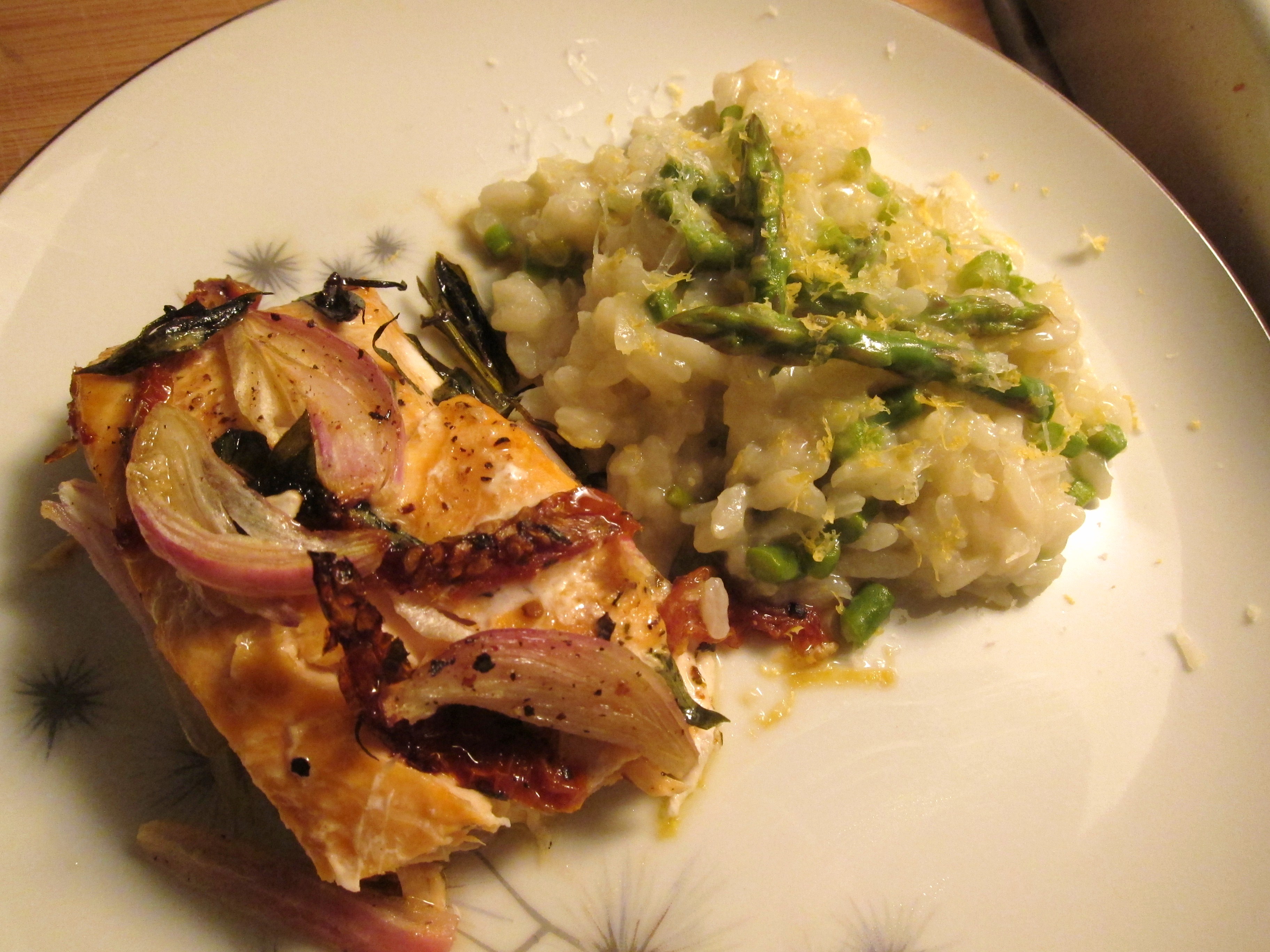
Asparagus Risotto with Lemon (serves 4)

  • 1 litre chicken stock (home-made is always better)
  • 1 1/2 cups Arborio rice
  • 1 small leek, finely chopped
  • 1/2 pack of asparagus, chopped – stalks and tips separated
  • 1/2 cup parmigiano reggiano (+ a bit for serving)
  • 1 wine glass of dry vermouth (or white wine)
  • 2 knobs of butter
  • 1tbsp olive oil
  • zest of 1/2 lemon
  • sea salt to taste

Heat the stock in a saucepan. Heat one knob of butter and the oil in a separate saucepan on medium-high heat. Once the butter and oil get a bit frothy, add the leek and cook until softened (don’t let it brown). Stir in the chopped asparagus stalks. Add the rice and give it good stir with a wooden spoon, ensuring that each kernel gets a good coating of fat*. Toast the rice for about 1 minute and then add the vermouth. Don’t be alarmed by the fantastic sizzle that will come from the pan.

Cook briefly, just until the vermouth has cooked into the rice. Add a ladleful of hot stock** and a pinch of salt. Stir lovingly and turn down the heat to medium-low. Continue adding ladlefuls of stock, waiting for each addition of stock to be absorbed into the rice before adding the next. About 12 minutes into cooking, add the asparagus tips (the “spear” part of the asparagus) and allow to cook for a couple of minutes.

At about the 15-minute mark, taste the rice to see if it is cooked. Like pasta, il should be al dente – not hard in the center, but not mushy either. If you run out of stock before the rice is cooked, don’t panic – just boil some water and add it a bit at a time like the stock.

Once the rice is cooked, remove from the heat and add the 2nd knob of butter. Taste again for salt. Grate lemon zest & parmigiano over risotto before serving.

*this step is what helps the rice stay firm and toothsome

**hot stock is key – cold stock will cool down your risotto for no good reason and will result in a hard, uncooked kernel.

Improvised baked salmon (serves 2-4 depending on the size of the filets)

  • 2 salmon fillets
  • 1 small shallot (échalotte), sliced
  • a couple of sundried tomatoes (in oil), sliced
  • a couple of lemon slices
  • fresh tarragon
  • olive oil
  • sea salt & pepper to taste

Preheat oven to 350°F. Place salmon skin-side down in a baking dish. Top with shallot, sundried tomatoes, tarragon, lemon slices, salt and pepper. Drizzle some olive oil on top. Bake for approximately 10 minutes, taking care not to overcook. The general rule of thumb is 8 minutes of cooking for each inch of thickness. Fatty fish like salmon is better when the outside is opaque but the center is still slightly translucent.

Share this:

  • Tweet
  • Share on Tumblr
Like Loading...
Newer posts →

Facebook

Facebook

Instagram

No Instagram images were found.

Recent Posts

  • Layers and Rows
  • Finding Buoyancy
  • February
  • Wednesday
  • Cross My Heart, Miso

Archives

  • May 2017
  • April 2017
  • February 2017
  • December 2016
  • November 2016
  • September 2016
  • August 2016
  • July 2016
  • June 2016
  • May 2016
  • April 2016
  • March 2016
  • February 2016
  • January 2016
  • December 2015
  • November 2015
  • October 2015
  • September 2015
  • August 2015
  • July 2015
  • June 2015
  • May 2015
  • April 2015
  • March 2015
  • February 2015
  • January 2015
  • December 2014
  • November 2014
  • October 2014
  • September 2014
  • August 2014
  • July 2014
  • June 2014
  • May 2014
  • April 2014
  • March 2014
  • February 2014
  • January 2014
  • December 2013
  • October 2013
  • September 2013
  • August 2013
  • July 2013
  • June 2013
  • May 2013
  • April 2013
  • March 2013
  • February 2013
  • January 2013
  • December 2012
  • November 2012
  • October 2012
  • September 2012
  • August 2012
  • July 2012
  • June 2012
  • May 2012
  • April 2012
  • March 2012
  • February 2012

Categories

  • Beverage
  • Breakfast & Brunch
  • Condiments
  • Cooking For Your Peeps
  • Cooking Solo
  • Cooking with Nonna
  • Food Away From Home
  • Food Writing
  • Holidays
  • Intro
  • Lunch & Dinner
  • Snacking
  • Soups
  • Sweet Tooth
  • The Basics
  • Vegetarian

Enter your email address to follow this blog and receive notifications of new posts by email.

Join 82 other subscribers

Blog at WordPress.com.

  • Subscribe Subscribed
    • julia chews the fat
    • Join 82 other subscribers
    • Already have a WordPress.com account? Log in now.
    • julia chews the fat
    • Subscribe Subscribed
    • Sign up
    • Log in
    • Report this content
    • View site in Reader
    • Manage subscriptions
    • Collapse this bar
 

Loading Comments...
 

    %d